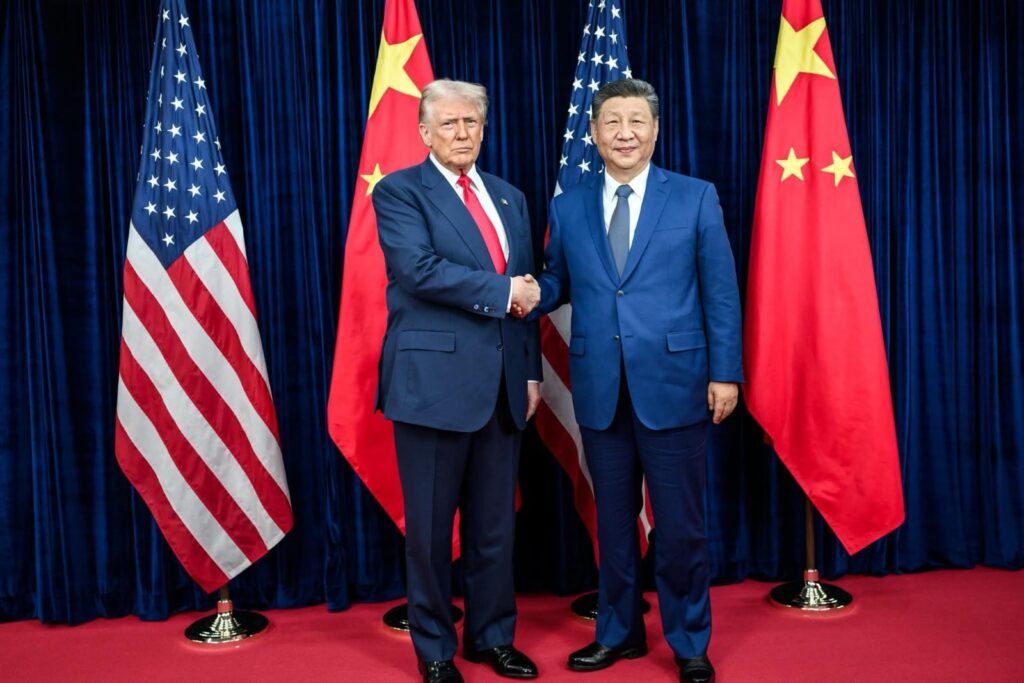
An ‘Amazing’ Meeting, but Questions Remain
In what is being described as one of the most anticipated diplomatic encounters of 2025, United States President Donald Trump and Chinese President Xi Jinping met in Busan, South Korea, for their first face-to-face meeting since 2019. The two leaders agreed to a trade truce aimed at de-escalating tensions between the world’s two largest economies.
Trump hailed the meeting as “amazing,” calling it the highlight of his Asia tour. However, analysts and global observers have voiced skepticism, describing the outcomes as symbolic rather than substantive.
A Shorter-Than-Expected Dialogue
The meeting lasted just one hour and 40 minutes, considerably shorter than the four hours Trump had earlier suggested. According to Shan Guo, a partner at Shanghai’s Hutong Research, this brevity indicates that discussions were largely pre-negotiated.
Despite the limited duration, Trump called the result “a 12 out of 10,” emphasizing optimism over what many see as a cautious pause in the ongoing trade conflict.
A Trade Truce, Not a Trade Deal
While the summit was touted as a success, experts clarified that this was not a trade deal but rather a temporary ceasefire in the prolonged US-China trade war. The agreement introduces a one-year freeze on certain economic hostilities, subject to renewal.
Under the terms:
- China will delay export restrictions on five rare earth metals, though seven others will remain restricted.
- Beijing agreed to intensify efforts to curb illegal fentanyl trafficking into the US.
- Washington will halve its 20% fentanyl-related tariff, lowering overall tariffs on Chinese goods from 57% to 47%.
- Chinese imports of US soya beans will resume immediately, a relief for American farmers.
- Both nations will suspend tit-for-tat port fees and technology-related export controls for a year.
The 301 investigation, which allows Washington to impose tariffs on unfair trade practices, will also be paused temporarily.
Rare Earths: Trump’s Strategic Win
Perhaps the most significant development was China’s agreement to delay restrictions on rare earth exports—materials vital to the production of smartphones, electric vehicles, and advanced weaponry.
Analysts described this as a major strategic win for Trump. China controls over 70% of global rare earth processing, making its decisions pivotal to global technology supply chains. However, experts warn that Beijing may still use this leverage in future negotiations.
“This deal buys time, not peace,” one analyst commented, noting that China could weaponize its rare earth dominance again if talks falter.
Semiconductors and Technology Tensions
A major focus of the discussion was semiconductor access, a flashpoint in US-China relations. The Trump administration, like its predecessor, has restricted exports of high-end AI chips, including Nvidia’s Blackwell processors, to limit China’s technological advancement.
Trump confirmed that semiconductors were discussed, though the Blackwell chips were “not on the table.” He hinted that future cooperation between Chinese firms and US tech giants like Nvidia might be possible.
This statement was cautiously received in Washington, where concerns persist about China’s access to advanced AI technologies and their potential military applications.
Fentanyl and Soya Beans: Domestic Wins for Trump
Two recurring themes in US-China relations — fentanyl and soya beans — again took center stage.
Fentanyl, a synthetic opioid responsible for tens of thousands of deaths annually in the US, has long been a point of contention. Trump praised China’s new commitment to “stop the flow,” saying he believed Xi was “taking strong action.”
Meanwhile, China’s decision to resume buying US soya beans is expected to ease tensions among Midwestern farmers, a vital part of Trump’s political base. Still, commodity markets reacted cautiously, with soya futures slipping after the summit due to a lack of concrete details.
China’s Message: Cooperation, Not Confrontation
According to Chinese state media, Xi reassured Trump that China does not seek to “challenge or replace any country.” Instead, he emphasized focusing on China’s domestic growth and stability, describing its economy as “an ocean capable of handling all storms.”
Xi called on both nations to pursue long-term cooperation over “short-term retaliation,” urging both sides to follow through on the consensus reached in Busan.
The Chinese Ministry of Commerce later confirmed that Trump will visit China in April 2026, with Xi expected to make a reciprocal trip to the US later that year.
Skepticism from Analysts
Despite the upbeat tone from both leaders, many experts question how much progress was truly made.
Einar Tangen, a senior fellow at Beijing’s Taihe Institute, said that Trump’s move to reduce tariffs from 57% to 47% “means nothing,” arguing that trade remains effectively blocked at such high rates.
“Until tariffs drop below 30%, you don’t have normal trade — just managed confrontation,” Tangen explained.
He also noted that no joint communique was released after the summit, making it difficult to assess the depth of the commitments made.
A Diplomatic Pause, Not a Breakthrough
While Trump framed the Busan summit as a landmark achievement, experts view it more as a temporary pause in escalating tensions than a true reconciliation. Both sides appear to have prioritized stability over substance, aiming to calm markets and reassure domestic audiences rather than resolve deep-rooted disputes.
The rare earth reprieve gives the US breathing room in critical tech sectors, while soya and fentanyl concessions help Trump domestically. China, in turn, gains time to manage its economy amid global headwinds without appearing to concede too much.
As one diplomat put it:
“This summit wasn’t about solving problems — it was about keeping the relationship from breaking completely.”
Looking Ahead
The Trump-Xi meeting in Busan underscores the fragile balance between competition and cooperation defining US-China relations. Both leaders have incentives to maintain calm ahead of upcoming political cycles, but underlying tensions in technology, security, and global influence remain unresolved.
Whether this “amazing” meeting becomes a stepping stone toward renewed engagement or just another diplomatic photo op will depend on what happens next — when the talks resume in Beijing next spring.