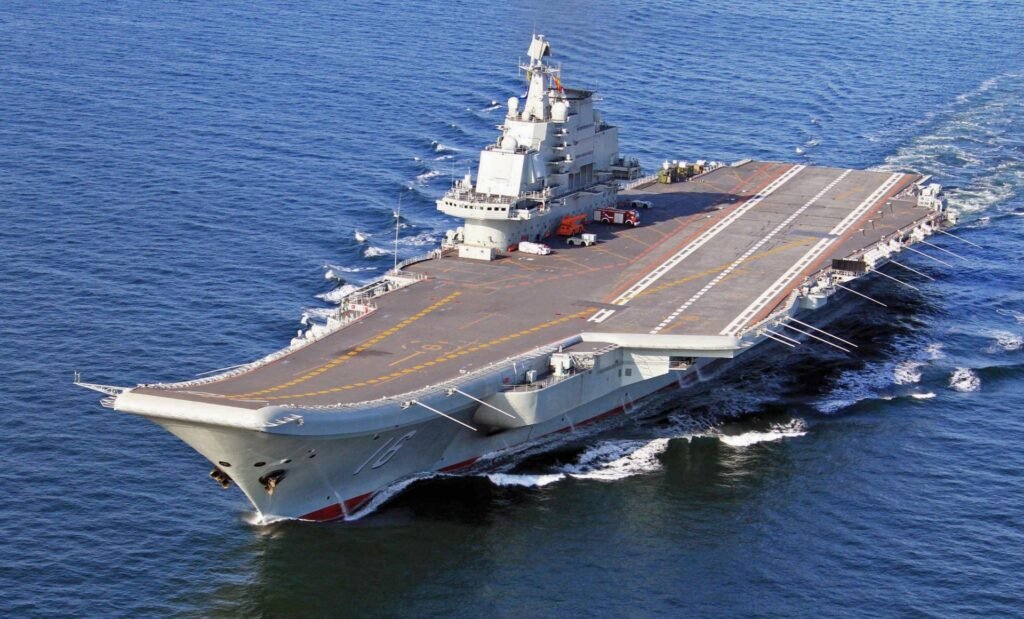
China has officially commissioned its newest and most advanced aircraft carrier, the Fujian, marking a major milestone in Beijing’s pursuit of naval dominance. The ceremony, attended by President Xi Jinping on Hainan Island, symbolizes China’s determination to challenge the United States in maritime power and regional influence.
Fujian: A Leap in China’s Naval Technology
The Fujian, China’s third aircraft carrier, stands out as a technological leap forward. It is the country’s first carrier equipped with Electromagnetic Aircraft Launch System (EMALS) — a feature only shared globally with America’s USS Gerald R. Ford. This advanced system allows aircraft to launch with heavier payloads, extending their strike range and improving overall combat capability.
During the commissioning, Xi personally inspected the vessel and symbolically pressed the carrier’s catapult button, signaling the start of a new era for China’s navy. The ship’s three catapult launch positions, coupled with carrier-based aircraft like the J-35, J-15T, and KJ-600, were showcased prominently.
A Symbol of National Pride and Military Strength
Launched in 2022 and tested through 2024, the Fujian’s official entry into service has ignited national pride across China. State media hailed the milestone as a testament to Xi’s vision of building a world-class military, while social media platforms saw millions of views under the hashtag celebrating the nation’s “first electromagnetic catapult-equipped aircraft carrier.”
At 80,000 tons, the Fujian rivals the U.S. Navy’s Nimitz-class carriers, underscoring Beijing’s rapid naval modernization. China’s navy, now the largest in the world by ship count, continues to expand at an unprecedented pace under Xi’s leadership.
Power Balance in the Asia-Pacific
Despite its rapid advancements, analysts note that the Fujian is still conventionally powered, unlike America’s nuclear carriers that can remain at sea indefinitely. Experts estimate that the Fujian’s air operations may still operate at only about 60% efficiency compared to older U.S. carriers due to deck configuration limitations.
Nevertheless, the Fujian demonstrates China’s growing capacity to project power beyond its shores — especially across the South China Sea and Indo-Pacific region. With another nuclear-powered carrier, the Type 004, already under construction, China is making it clear that its ambitions on the high seas are only expanding.