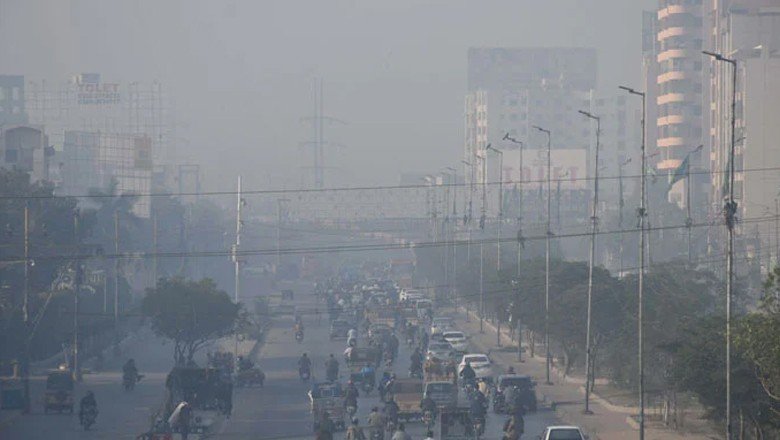
Karachi’s air quality has once again fallen into the hazardous category, sparking health concerns for millions of residents. According to the latest Air Quality Index (AQI) reports updated Friday evening, several parts of the city recorded dangerously high PM2.5 concentrations, posing severe risks to public health.
Air Quality Reaches Hazardous Levels Across Karachi
Recent monitoring data revealed that PM2.5 levels across various areas in Karachi ranged between 138 and 200 µg/m³, far exceeding the World Health Organization’s safe limit of 15 µg/m³.
The Urban Resource Center in Jamshed Town and Asif Gulistan-e-Johar in Gulshan District reported the highest pollution levels, each reaching an alarming 200 µg/m³, categorizing them as “Very Unhealthy.” Similarly, G3 Engineering Consultants reported 199, while NED University City Campus followed closely with 185.
Other sites like Agha Khan University (171), Orangi Pilot Project (172), Malir District (175), and North Nazimabad (176) also recorded unsafe readings. Even the lowest figure, 138 µg/m³ in Keamari Town, remains well above international safety standards.
Experts Warn of Health Hazards
Environmental experts and health professionals are urging Karachi residents to take urgent precautionary measures. Prolonged exposure to such air quality can cause respiratory and cardiovascular diseases, especially among children, elderly citizens, and individuals with preexisting health issues.
Citizens are advised to limit outdoor activities, wear protective masks, and use air purifiers indoors to minimize exposure.
Understanding the AQI Scale
The Air Quality Index (AQI) categorizes air pollution levels as follows:
- 0–50: Good – Minimal risk to health
- 51–100: Moderate – Acceptable for most, mild concern for sensitive groups
- 101–150: Unhealthy for sensitive groups
- 151–200: Unhealthy – Everyone may experience health effects
- 201–300: Very Unhealthy – Emergency-level health warnings
- 300+: Hazardous – Serious risk for all
Karachi’s current readings place it in the “Unhealthy to Very Unhealthy” range, signaling a critical need for environmental reforms and stronger pollution control measures.
Call for Action
Environmental watchdogs are calling on local authorities to prioritize sustainable urban planning, stricter emissions controls, and better waste management. The deteriorating air quality not only affects citizens’ health but also underscores the urgent environmental crisis confronting Pakistan’s largest city.