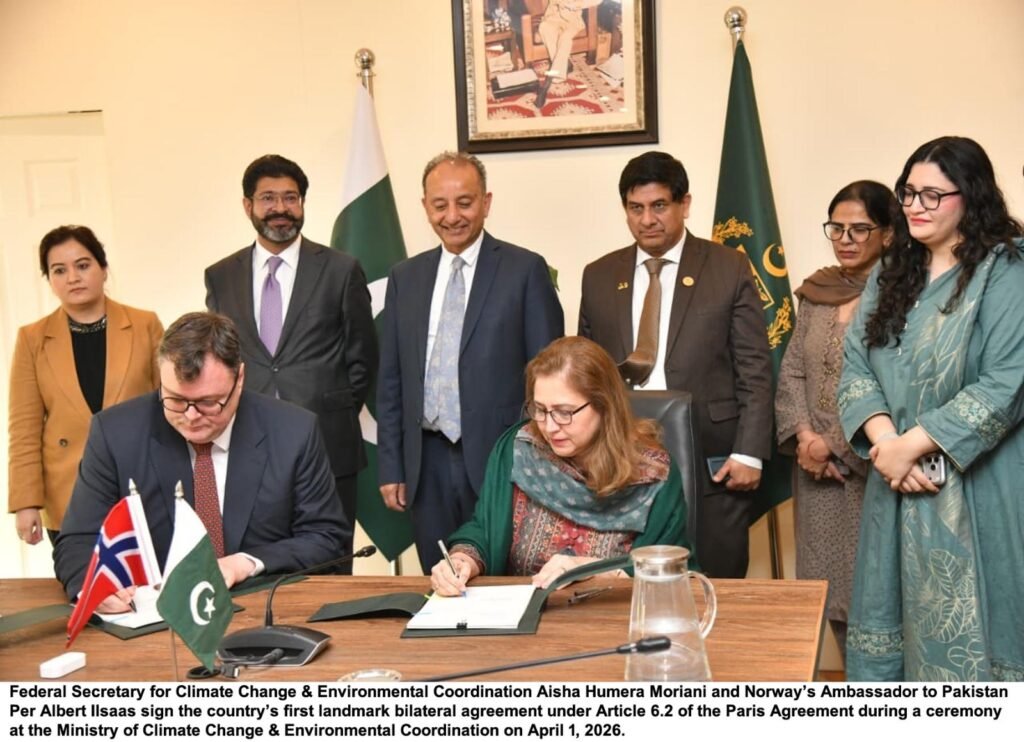
ISLAMABAD (April 2026) — In a major diplomatic and economic breakthrough, Pakistan has signed its first-ever bilateral climate agreement under Article 6.2 of the Paris Agreement, opening doors to international carbon trading, green investment, and clean energy financing.
This landmark pact with Norway marks a turning point in Pakistan’s climate policy, positioning the country as an emerging player in the global carbon market while addressing urgent environmental challenges.
A Historic Step in Pakistan’s Climate Diplomacy
The agreement, signed under the Ministry of Climate Change and Environmental Coordination, signals Pakistan’s transition from climate readiness to real implementation.
Federal Minister Musadik Malik described the deal as a “historic milestone”, emphasizing its role in enabling international cooperation, climate finance, and sustainable development.
This move places Pakistan firmly on the global stage as it aligns with Paris Agreement goals and strengthens its climate diplomacy.
What Article 6.2 Means for Pakistan
Article 6.2 of the Paris Agreement allows countries to trade carbon credits internationally. Under this system:
- Pakistan can develop emission-reduction projects
- These projects generate carbon credits (ITMOs)
- Credits can be sold to countries like Norway
This creates a new revenue stream while promoting low-carbon growth.
Key Sectors Set to Benefit
The agreement will accelerate investment across multiple sectors critical to Pakistan’s economy:
🌱 Clean Energy Expansion
Projects in solar, wind, and renewable energy will receive global funding support.
🚜 Climate-Smart Agriculture
Farmers can adopt sustainable practices, improving productivity while reducing emissions.
🚗 Green Transport Systems
Investment in low-emission transport infrastructure will reduce urban pollution.
♻️ Waste Management Solutions
Modern waste systems will help cities cut emissions and improve sanitation.
These sectors highlight Pakistan’s strong mitigation potential, making it attractive for international investors.
Boost for Climate Finance and Green Economy
Pakistan faces increasing climate risks, including floods, heatwaves, and extreme weather events. This agreement provides a pathway to:
- Unlock international climate finance
- Attract foreign direct investment (FDI)
- Create green jobs and technology transfer
- Support sustainable economic growth
Officials believe this could significantly strengthen Pakistan’s green economy ecosystem.
Norway’s Strategic Climate Partnership
Norway, aiming for climate neutrality by 2030, is investing heavily in global climate initiatives.
Through its Global Emission Reduction Initiative (NOGER)—a $1.5 billion fund—Norway plans to:
- Purchase 15 million carbon credits by 2030
- Support large-scale climate projects
- Partner with developing countries like Pakistan
Norway’s Ambassador Per Albert Ilsaas highlighted that this collaboration goes beyond targets, aiming for real environmental and development impact.
From Policy to Implementation: Pakistan’s Readiness
Pakistan has already laid the groundwork for carbon trading:
- National Carbon Market Policy (2025) approved
- Development of reporting and regulatory systems
- Framework for bilateral climate agreements
The new deal accelerates implementation, encouraging project developers and investors to enter the market.
Major Projects on the Horizon
Norway has shown interest in large-scale renewable projects in Pakistan, including:
- 100 MW solar energy projects
- Wind energy initiatives in the Indus region
These projects could become flagship examples of carbon credit generation and clean energy transition.
Why This Agreement Matters for Pakistan
This deal is more than just a climate agreement—it’s an economic opportunity.
Key Impacts:
- Strengthens Pakistan’s global climate position
- Enables carbon credit exports
- Drives sustainable infrastructure development
- Supports Paris Agreement commitments
Most importantly, it connects climate action with economic growth and job creation.
The Bigger Picture: A Green Future for Pakistan
Pakistan’s entry into the global carbon market signals a shift toward long-term sustainability. By leveraging international partnerships, the country can:
- Reduce carbon emissions
- Build climate resilience
- Modernize its energy sector
- Attract global investors
This agreement lays the foundation for a clean, green, and economically stronger Pakistan.
Final Verdict
The Pakistan–Norway climate accord is a game-changing development in the country’s political and economic landscape. It not only unlocks carbon finance and green investment but also positions Pakistan as a serious contender in the global climate economy. The source of this news is https://mocc.gov.pk/
As implementation begins, the real success will depend on how effectively Pakistan converts this opportunity into on-ground projects, investor confidence, and sustainable growth.
Stay connected with HumdardNews.com for the latest updates on Pakistan politics, climate policy, and global partnerships shaping the nation’s future.