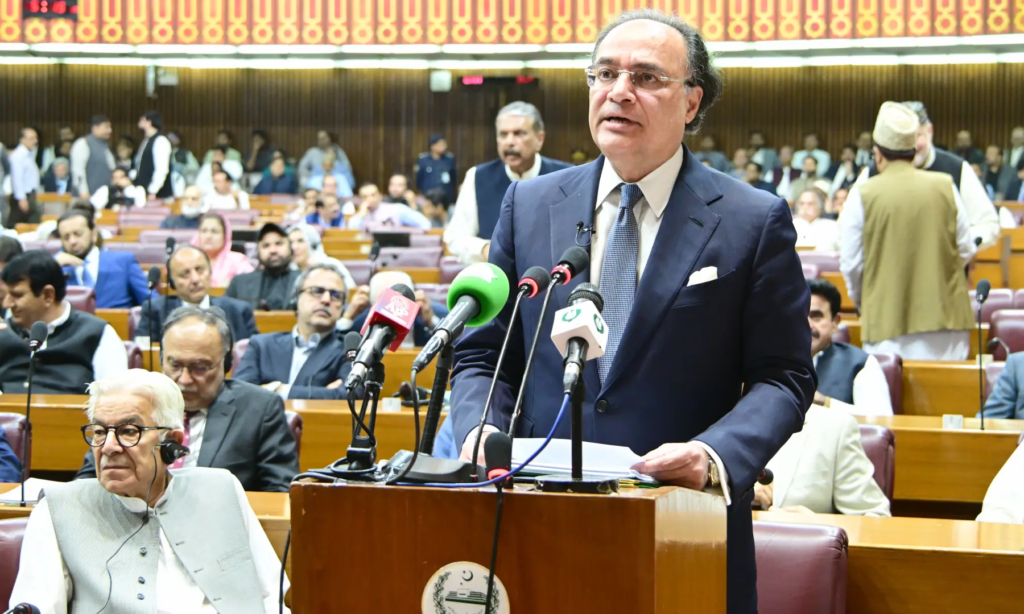
Pakistan’s federal government has unveiled a massive Rs18.8 trillion budget for fiscal year 2026-27, setting an ambitious economic roadmap focused on growth, fiscal discipline, tax reforms, social protection, and national development. Finance Minister Muhammad Aurangzeb presented the budget in the National Assembly amid strong opposition protests, outlining the government’s vision to achieve 4 percent GDP growth while maintaining average inflation at 8.2 percent.
The FY2026-27 budget reflects the government’s strategy to strengthen economic stability, increase exports, attract investment, expand social welfare programs, and improve tax compliance without placing additional burdens on ordinary citizens.
Key Highlights of Pakistan Budget 2026-27
The federal budget for FY2026-27 includes several major relief measures and development initiatives:
- GDP growth target set at 4 percent
- Inflation projected at 8.2 percent
- Federal budget outlay fixed at Rs18.8 trillion
- Government employees to receive a 7 percent salary increase
- Pensioners to get a 7 percent raise
- Minimum wage proposed to increase by 10 percent
- Income tax relief announced for salaried individuals in multiple income slabs
- Tax on sanitary pads and contraceptives completely abolished
- Withholding tax on foreign debit and credit card transactions reduced from 5 percent to 0.5 percent
- Final Tax Regime for IT companies and freelance exporters extended until FY2030
- Benazir Income Support Programme (BISP) allocation increased by 17 percent
- Rs71 billion allocated for the Prime Minister’s Apna Ghar Housing Scheme
- National Artificial Intelligence Ecosystem Development Programme launched as a flagship $1 billion initiative
Economic Growth and Inflation Targets
The government expects Pakistan’s economy to grow by 4 percent during FY2026-27. The target comes after an estimated 3.7 percent growth in the outgoing fiscal year.
Average inflation is expected to remain at 8.2 percent, while the fiscal deficit target has been set at 3.6 percent of GDP. The government is also aiming for a primary surplus of 2 percent, demonstrating its commitment to fiscal responsibility and economic reforms.
Officials believe that improvements in industrial output, exports, remittances, and investor confidence will support economic expansion during the upcoming year.
Tax Relief for Salaried Class and Businesses
One of the most anticipated features of the federal budget is the reduction in income tax rates for several salaried income brackets.
Individuals earning between Rs2.2 million and Rs3.2 million annually will now pay a maximum tax rate of 20 percent instead of 23 percent. Additional reductions have also been proposed for higher income categories.
The government has further proposed:
- Elimination of the 9 percent surcharge on salaried individuals
- Abolition of super tax for businesses earning between Rs150 million and Rs500 million annually
- Reduction in super tax from 10 percent to 8 percent for larger corporations
These measures are designed to encourage investment, improve business activity, and provide relief to taxpayers.
Major Focus on Social Welfare
The government has significantly expanded funding for social protection programs.
The Benazir Income Support Programme budget has been increased by 17 percent to Rs838 billion, with beneficiary coverage expected to reach 12 million families.
In addition, Rs2.68 trillion has been allocated for BISP, Azad Jammu and Kashmir, Gilgit-Baltistan, and merged districts of Khyber Pakhtunkhwa, highlighting the government’s focus on inclusive development and poverty reduction.
Housing, Technology and Digital Economy
To promote affordable housing, the government has allocated Rs71 billion for the Prime Minister’s Apna Ghar Scheme. The initiative includes access to housing finance through a 5 percent mortgage facility, aiming to support low and middle-income households.
A major highlight of the budget is the launch of the National Artificial Intelligence Ecosystem Development Programme. The $1 billion initiative is expected to accelerate Pakistan’s digital transformation, boost innovation, strengthen the technology sector, and create opportunities for young professionals.
The extension of the Final Tax Regime for IT exporters and freelancers until FY2030 is also expected to support Pakistan’s rapidly growing digital economy and increase export earnings.
Defence and Development Spending
The government has allocated Rs3 trillion for defence expenditures, citing evolving regional security challenges and the need to maintain national preparedness.
Meanwhile, Rs1 trillion has been earmarked for the Public Sector Development Programme (PSDP), while total development spending rises to Rs1.451 trillion after including public-private partnerships and state-owned enterprise investments.
Key sectors expected to benefit include infrastructure, energy, transport, housing, and technology development.
Revenue Targets and Fiscal Management
The Federal Board of Revenue (FBR) has been assigned a tax collection target of Rs15.264 trillion, representing a significant increase from the previous fiscal year.
Federal non-tax revenue is projected at Rs5.336 trillion, while net federal revenue is estimated at Rs11.751 trillion.
The government plans to increase revenue collection through stronger enforcement, digitisation, compliance reforms, and broadening the tax base rather than imposing new taxes on the public.
Political Tensions During Budget Session
The budget session witnessed intense political activity as opposition lawmakers staged protests inside the National Assembly. Members of the opposition raised slogans, displayed placards, and criticised the government’s economic policies.
Meanwhile, coalition partner PPP also voiced concerns regarding Sindh’s water share and political representation. Despite reservations, PPP leaders participated in the budget process and continued consultations with the federal government.
Conclusion
Pakistan’s Budget 2026-27 presents a comprehensive economic strategy aimed at balancing growth, stability, welfare, and development. With tax relief for the salaried class, increased social protection funding, support for the IT sector, investment in artificial intelligence, housing initiatives, and higher allocations for development projects, the government hopes to accelerate economic recovery and strengthen long-term growth.
The success of the budget will largely depend on effective implementation, revenue collection performance, inflation management, and the government’s ability to maintain investor confidence while addressing the economic challenges facing Pakistan. The source of this news is Dawn.